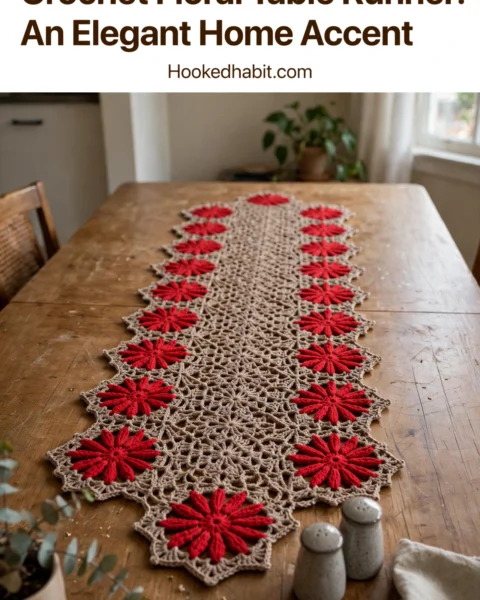
I have completely fallen for this lace runner, friends — those little circular medallions joining together into something so delicate and intricate, I just can’t stop admiring it. Each motif locks into the next to form an openwork fabric that feels almost architectural, yet still soft and romantic and heirloom-pretty.
The Lace Runner
This is the kind of piece that makes guests pause mid-sentence to run their fingers across it. Each medallion radiates outward from a tightly worked center, like a pressed flower preserved in thread — airy and structured all at once. The scalloped edges and tiny picot details give it that vintage lace character, as if it belongs on an antique sideboard or under a pitcher of wildflowers. It’s made for the maker who loves watching something refined grow from nothing but a hook and a spool of fine thread.
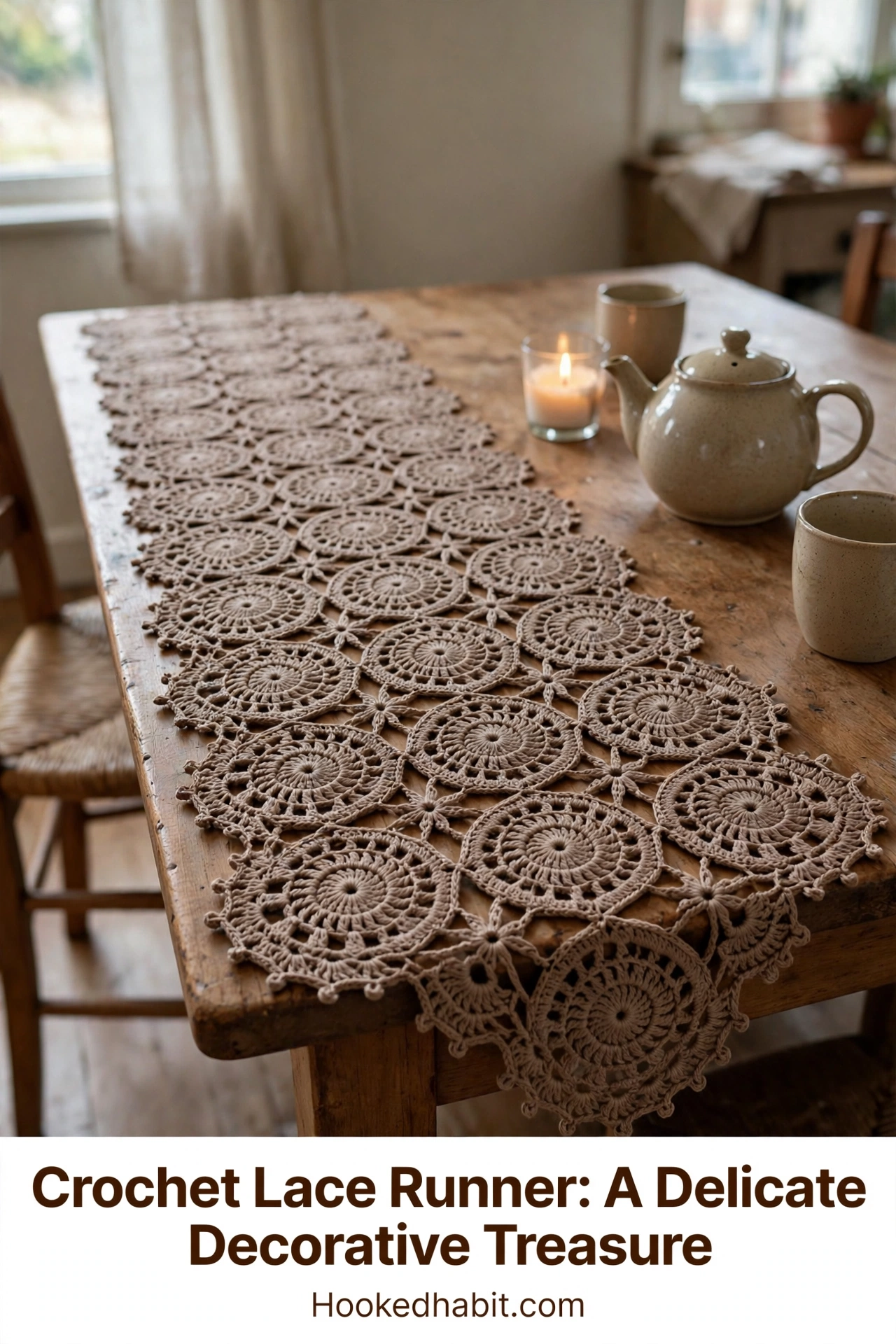
The warm taupe in the photos is just lovely — somewhere between linen and blush — but this runner would be equally beautiful in ivory, sage, or dusty rose. A deeper walnut brown would give it a cozy, autumnal mood, while a crisp natural white keeps it fresh and classic for any season. This is one of those pieces that completely changes personality with the color you choose, which makes it wonderfully versatile.
Materials and Tools
To get that clean, crisp definition you see in the finished piece, reach for a fingering weight or lace weight cotton thread. A fine mercerized cotton is ideal — that slight sheen is exactly what makes the texture catch the light so prettily. A 1.5mm to 2mm steel hook keeps your stitches tight and even so the medallions hold their shape without any puckering. Keep a pair of small embroidery scissors handy for snipping joining ends neatly between motifs, and have a blocking board at the ready — this piece truly transforms with a proper wet block.
Stitch by Stitch
Just a small, friendly set of stitches builds all this lace — and they feel very approachable once you’ve worked through your first medallion.
SC (Single Crochet) Used to form tight, stable joins between motifs and to anchor the central ring of each medallion.
DC (Double Crochet) The primary building stitch of each round, creating the open, lacy arches that give the runner its delicate structure.
CH (Chain Stitch) Works as the foundation ring and forms the decorative chain loops that arc between DC clusters throughout every round.
Picot A small decorative loop, typically worked as CH 3 then a slip stitch back into the base stitch, that edges each medallion with tiny pointed detail.
Once your hands learn the rhythm — ring, chain, double crochet, picot — the pattern becomes almost second nature. You’ll find yourself working round after round in a quiet, focused calm, which is honestly one of the great pleasures of fine thread crochet.
Construction
Each medallion is worked on its own in the round, starting from a magic ring or a small chain loop and growing outward through several rounds of increasing detail. As you finish Round 3 of each new motif, you join it to its finished neighbor with slip stitches or picot joins at the connection points — the original pattern’s video tutorial demonstrates this part beautifully. The medallions sit in a diagonal, offset arrangement, which is what gives the runner its lovely elongated diamond shape instead of a plain rectangle — achieved simply by joining different sides of each motif as you go. Want a longer or shorter runner? Just add or remove rows of medallions to fit your table.
Wearing Your Lace Runner
This runner was born for a long dining table under candlelight and little bud vases — but it’s just as sweet across an entryway console or laid at the foot of the bed for a soft, collected look. Style it with linen napkins and mismatched vintage glasses for a Sunday brunch table that feels truly special. Fair warning: once you finish this one, you’ll want to make a second in another colorway.
Washing and Storing Your Lace Runner
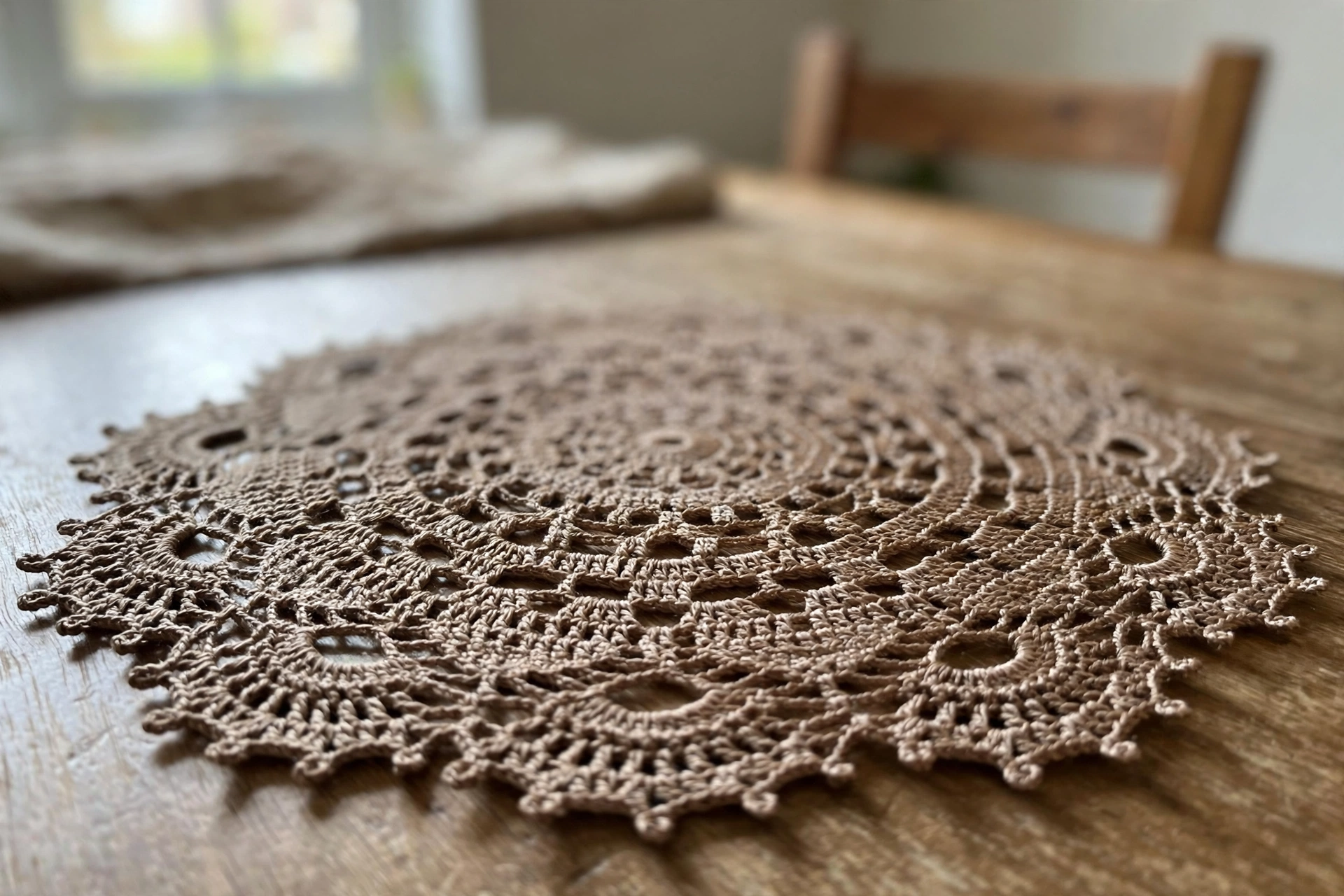
Fine cotton thread loves a gentle hand wash in cool water with a mild wool or delicate fiber wash, followed by a careful press between two towels to take out the excess moisture. And please don’t skip the blocking — this is the moment the whole piece truly comes alive. Pin it out to your measurements on a foam board, coaxing each picot edge and medallion curve into shape, and let it dry completely flat. For storage, roll it loosely around a cardboard tube wrapped in acid-free tissue so the lace never creases.
Every row of this runner is a small act of patience you can see — and the finished piece carries that care in every open loop and joined medallion.