Crocheting a full lace dress sounds intimidating, doesn’t it? I know the feeling — you see something this beautiful and think it must be reserved for the most experienced makers, the ones with decades of patience tucked into their yarn baskets.

But here is the truth, sweet friend: if you can work basic stitches in the round and follow along one section at a time, you can absolutely create this dress. Yes, it takes time. Yes, there are several stitch patterns to learn. But broken down into gentle, manageable pieces, this bohemian lace dress is far more achievable than it looks — and oh, so worth it.
Whether you are an adventurous intermediate crocheter ready to stretch your wings, or an advanced maker searching for your next showpiece, this sage green beauty will walk you through every single step. Let’s melt away that intimidation together.
About This Crochet Dress Pattern
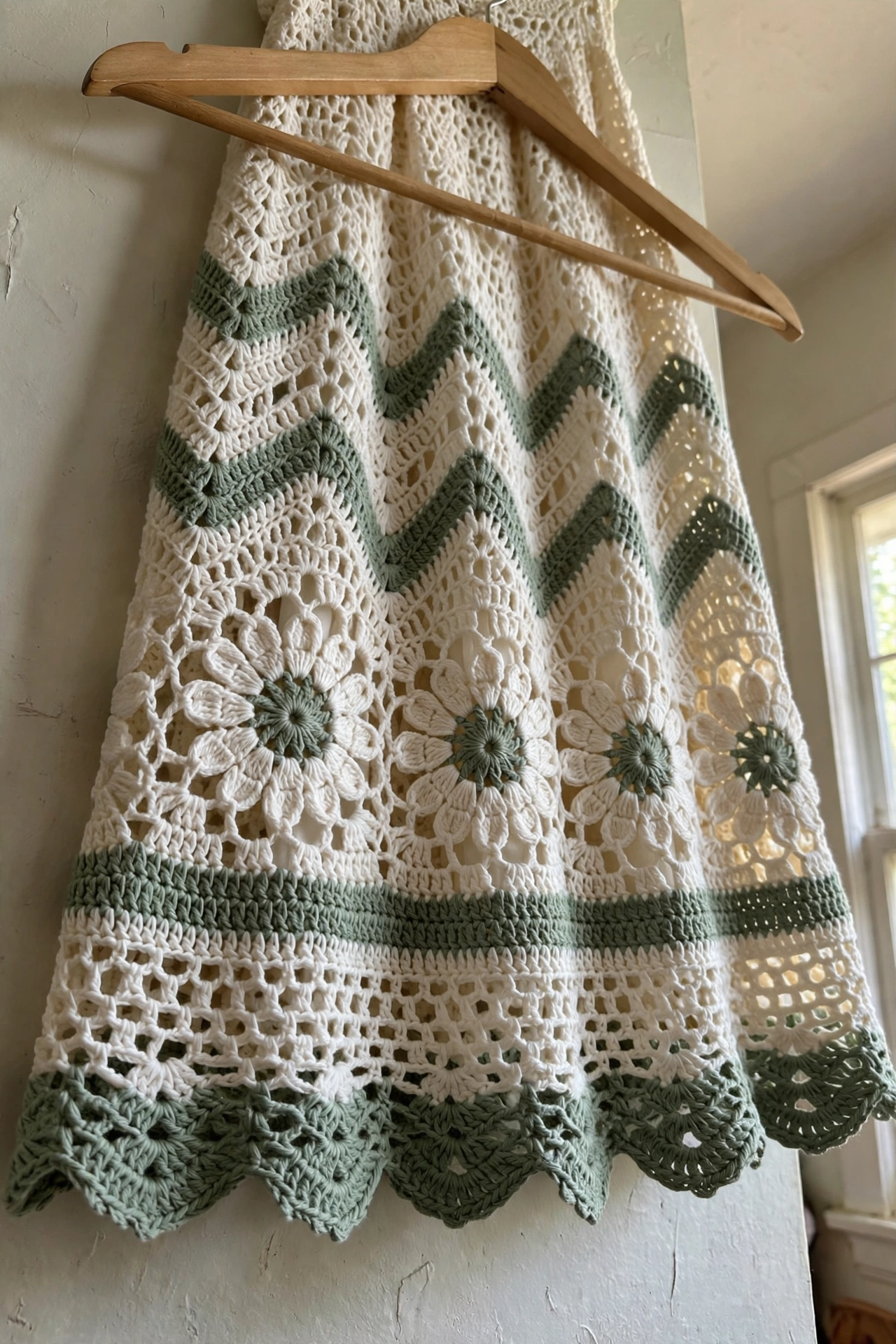
This stunning midi-length dress is worked in the round from the top down. You will begin at the neckline yoke and journey through a shaped bodice into a full, tiered skirt. The dress features alternating lace panels separated by gorgeous sage green chevron stripe accents, and the neckline and cap sleeves finish with a scalloped edging that frames your shoulders so beautifully.
What makes this pattern so special, darling, is the delicious variety of textures you will create along the way — from V-stitch fans to honeycomb mesh to those eye-catching circular daisy motifs. Each section teaches you something new while building on skills you already have.
The dress slips right over your head — no closures to fuss with. The generous neckline makes it effortless to put on and a dream to wear. I do suggest a fabric slip underneath for modesty and structure, since the lace is naturally open and airy.
Skill Level
This is an advanced crochet pattern, love. You will want to feel confident working in the round on fitted garments, reading stitch counts across several pattern sections, joining motif rounds seamlessly, shaping directionally across lace patterns, and changing colors without visible jogs.
But do not let that scare you off. If you have made a few garments and feel at home with lace stitches, you are ready — the whole secret is taking it one section at a time.
Time Estimate
Plan for 80 to 120 hours at an average pace — lace rounds and motif joins take far longer than solid fabric. It is truly a labor of love, and the finished dress is worth every single stitch.
Finished Measurements
This pattern is written for size Medium; here are the finished measurements:
-
Bust: 36 inches (91.5 cm)
-
Waist: 28 inches (71 cm)
-
Hip: 40 inches (101.5 cm)
-
Total length from neckline to hem: 42 inches (106.5 cm)
-
Yoke depth: 6 inches (15 cm)
-
Bodice length below yoke to waist: 9 inches (23 cm)
-
Skirt length from waist to hem: 27 inches (68.5 cm)
Tips for customizing the size wait for you at the end of this pattern.
Materials Needed
Yarn A (Main Color): Cream or off-white, sport weight (CYCA 2), approximately 1,800 yards (1,645 meters)
Yarn B (Contrast Color): Sage green, sport weight (CYCA 2), approximately 600 yards (549 meters)
Crochet Hook: US size E-4 / 3.5 mm
Additional Supplies:
-
8 locking stitch markers
-
Tapestry needle for weaving ends
-
Scissors
-
Measuring tape
-
Rust-proof blocking pins (minimum 50)
-
Blocking mats
-
Optional: 2 yards (1.8 meters) of jersey knit or cotton lawn fabric for lining
-
Optional: 1 yard (0.9 meters) of 1-inch non-roll elastic for waist lining casing
Yarn Suggestions
Option 1: Paintbox Yarns Simply DK (100% acrylic, 137 yards per 50 gram skein). This yarn is machine washable, affordable, widely available, and gives excellent stitch definition. Pair shade “Cream” with shade “Grass Green” or “Duck Egg Blue” for the sage accent. You will need approximately 14 skeins cream and 5 skeins sage.
Option 2: Drops Safran (100% Egyptian cotton, 175 yards per 50 gram skein). Cotton drapes beautifully for warm-weather dresses. Pair shade “Off White” with shade “Dusty Green.” You will need approximately 11 skeins cream and 4 skeins sage. Note that cotton has less stretch, so swatch carefully and check your gauge.
Option 3: WeCrochet Comfy Sport (75% pima cotton, 25% acrylic, 136 yards per 50 gram skein). This blend offers excellent drape with slight stretch for comfort. Pair shade “Bare” with shade “Aloe.” You will need approximately 14 skeins cream and 5 skeins sage.
Substitution Note: Any smooth sport weight yarn that gives 5.5 stitches per inch in single crochet will work. Skip fuzzy or halo yarns — they hide the lace motifs. Cotton or cotton-blend yarns give the most authentic drape for this style of garment.
Gauge
With US E-4 / 3.5 mm hook and sport weight yarn:
20 stitches and 22 rounds = 4 inches (10 cm) in single crochet worked in the round, after blocking.
Lace gauge: One 8-stitch fan repeat in the V-stitch fan section = 1.6 inches (4 cm) wide.
Motif gauge: One daisy motif (full circle, 12-round motif) = 4 inches (10 cm) in diameter after blocking.
Gauge is critical for a fitted garment. Work a 6-by-6 inch swatch, block it, and measure before beginning. Trust me on this one.
Abbreviations
-
beg: beginning
-
ch: chain
-
ch-sp: chain space
-
dc: double crochet (yarn over, insert hook, pull up loop, yarn over and pull through 2 loops twice)
-
dec: decrease
-
hdc: half double crochet (yarn over, insert hook, pull up loop, yarn over and pull through all 3 loops)
-
inc: increase
-
lp(s): loop(s)
-
MC: main color (Cream, Yarn A)
-
CC: contrast color (Sage Green, Yarn B)
-
pm: place marker
-
rem: remaining
-
rep: repeat
-
rnd: round
-
RS: right side
-
sc: single crochet (insert hook, pull up loop, yarn over and pull through both loops)
-
sk: skip
-
sl st: slip stitch
-
sm: slip marker
-
sp: space
-
st(s): stitch(es)
-
tog: together
-
tr: treble crochet (yarn over twice, insert hook, pull up loop, yarn over and pull through 2 loops three times)
-
WS: wrong side
-
yo: yarn over
-
[ ]: work instructions in brackets the number of times indicated
-
( ): stitch count at end of row or round
Special Stitches
V-Stitch Fan (V-Fan)
This stitch creates a wide, airy fan of double crochets divided by a chain space.
Step 1: Work (dc, ch 2, dc) all into the same stitch or space. This is one V-stitch.
Step 2: For a full fan, work (2 dc, ch 2, 2 dc) into the same stitch or space.
Step 3: Skip the number of stitches indicated in the pattern before working the next fan.
The V-Fan repeat throughout this pattern is: sk 3 sts, work (2 dc, ch 2, 2 dc) in next st, sk 3 sts, sc in next st. This 8-stitch repeat produces one fan per 8 stitches.
Chevron Shell Stitch (Chev-Shell)
This stitch builds the wavy sage-green horizontal stripes that give the dress its signature look.
Step 1: Work 5 dc all into the same stitch to form a shell (this is your increase point or peak).
Step 2: Skip 2 stitches, sc in next stitch (this is your valley point).
Step 3: Skip 2 stitches, work 5 dc into next stitch (next shell/peak).
Continue alternating shell peaks and sc valleys around the round. The repeat for Chev-Shell is: 5 dc in peak st, sk 2 sts, sc in next st, sk 2 sts. This is a 6-stitch repeat with designated peaks and valleys established in the first chevron round.
Daisy Motif (Worked Flat, Joined in Final Round)
Each motif is a 12-round circle worked flat. These create the stunning floral bands in the skirt.
Round 1: With CC, make magic ring, ch 1, work 8 sc into ring, sl st to join. (8 sc)
Round 2: Ch 3 (counts as dc), dc in same st, 2 dc in each st around, sl st to join. (16 dc)
Round 3: Ch 1, sc in same st, ch 3, sk 1 st, [sc in next st, ch 3, sk 1 st] 7 times, sl st to join. (8 ch-3 sps)
Round 4: Sl st into ch-3 sp, ch 1, (sc, hdc, 3 dc, hdc, sc) in each ch-3 sp around, sl st to join. (8 petals)
Round 5: Working behind petals, [ch 4, sl st in next sc between petals] 8 times. (8 ch-4 lps)
Round 6: Sl st into ch-4 lp, ch 1, (sc, hdc, 5 dc, hdc, sc) in each ch-4 lp around, sl st to join. (8 petals)
Round 7: Working behind petals, [ch 5, sl st in next sc between petals] 8 times. (8 ch-5 lps)
Round 8: Change to MC. Sl st into ch-5 lp, ch 3 (counts as dc), 6 dc in same lp, ch 1, [7 dc in next lp, ch 1] 7 times, sl st to join to top of beg ch-3. (56 dc, 8 ch-1 sps)
Round 9: Ch 4 (counts as dc, ch 1), [dc in next dc, ch 1] 6 times, dc in ch-1 sp, ch 1, [dc in next dc, ch 1] 7 times, dc in ch-1 sp, ch 1, rep from beginning around, sl st to join. (64 dc, 64 ch-1 sps)
Round 10: Ch 1, sc in each dc and each ch-1 sp around, sl st to join. (128 sc)
Round 11: Ch 5 (counts as dc, ch 2), sk 1 st, [dc in next st, ch 2, sk 1 st] around, sl st to join to 3rd ch of beg ch-5. (64 dc, 64 ch-2 sps)
Round 12 (Joining Round): Sc in each dc and 2 sc in each ch-2 sp around, joining to adjacent motifs or to dress fabric as directed. (192 sc)
Each completed motif measures 4 inches (10 cm) in diameter after blocking.
Scallop Edging
Step 1: Join yarn in any stitch, ch 1, sc in same st.
Step 2: Sk 2 sts, work 6 dc in next st, sk 2 sts, sc in next st.
Step 3: Rep step 2 around entire edge.
Step 4: Sl st to first sc to close. Fasten off.
Picot Join
Ch 3, sl st in first ch of the 3 just made. This creates a small decorative picot used at motif junction points.
Shell Increase (Shell-Inc)
Work (dc, ch 1, dc, ch 1, dc) all in the same stitch. This is used during skirt expansion shaping.
Pattern Notes
-
The dress is worked from the top down in continuous rounds unless otherwise stated.
-
Color changes: When changing from MC to CC or back, work the last yarn over of the final stitch in the old color with the new color. Carry the unused yarn on the wrong side for no more than 4 stitches. Otherwise, cut and rejoin to avoid distorting the fabric.
-
The yoke is worked in rounds with raglan-style increases at 4 points. Then the body is worked in one seamless tube to the waist, and the skirt flares outward via built-in stitch pattern increases.
-
Turning chains: This pattern does not use turning chains in the round. The beg ch-1 for single crochet rounds does not count as a stitch. The beg ch-3 for double crochet rounds counts as one dc.
-
Stitch markers should be placed at the raglan increase points during the yoke and moved up each round.
-
All lace sections benefit substantially from wet blocking. Do not skip blocking, especially for the motif bands.
-
The daisy motifs in the skirt bands are worked separately and then joined using the join-as-you-go method in their final round. They are then sewn or slip stitch joined to the adjacent lace fabric above and below.
-
The cap sleeves are created by working across the sleeve stitches of the yoke after the body join and finishing them with the scallop edging. They are not worked separately.
Instructions
Section 1: Neckline and Yoke
The neckline is 22 inches (56 cm) in circumference. At gauge this equals 110 stitches around.
Foundation: With CC and US E-4 hook, ch 111, sl st to first ch to form ring, being careful not to twist.
Rnd 1 (Neckline Base): Ch 1, sc in each ch around, sl st to first sc to join. (110 sc)
Rnd 2: Ch 1, sc in each st around, sl st to join. (110 sc)
Rnd 3: Ch 1, [sc in next 10 sts, 2 sc in next st] 10 times, sl st to join. (120 sc)
Rnd 4: Ch 1, sc in each st around, sl st to join. (120 sc)
Now establish the 4 raglan increase points. The neckline divides as follows:
-
Front: 36 sts
-
Back: 36 sts
-
Left sleeve: 24 sts
-
Right sleeve: 24 sts
-
Total: 36 + 36 + 24 + 24 = 120 sts
Place markers at stitch 1, stitch 37, stitch 61, and stitch 85 to mark the 4 raglan points.
Rnd 5 (Raglan Increase Round): Ch 1, [sc to 1 st before marker, 3 sc in marked st, sm] 4 times, sc to end of round, sl st to join. (128 sc)
Rnd 6: Ch 1, sc in each st around, sl st to join. (128 sc)
Rnd 7: Ch 1, [sc to 1 st before marker, 3 sc in marked st, sm] 4 times, sc to end of round, sl st to join. (136 sc)
Rnd 8: Ch 1, sc in each st around, sl st to join. (136 sc)
Rnd 9: Ch 1, [sc to 1 st before marker, 3 sc in marked st, sm] 4 times, sc to end of round, sl st to join. (144 sc)
Rnd 10: Ch 1, sc in each st around, sl st to join. (144 sc)
Rnd 11: Ch 1, [sc to 1 st before marker, 3 sc in marked st, sm] 4 times, sc to end of round, sl st to join. (152 sc)
Rnd 12: Ch 1, sc in each st around, sl st to join. (152 sc)
Rnd 13: Ch 1, [sc to 1 st before marker, 3 sc in marked st, sm] 4 times, sc to end of round, sl st to join. (160 sc)
Rnd 14: Ch 1, sc in each st around, sl st to join. (160 sc)
Rnd 15: Ch 1, [sc to 1 st before marker, 3 sc in marked st, sm] 4 times, sc to end of round, sl st to join. (168 sc)
Rnd 16: Ch 1, sc in each st around, sl st to join. (168 sc)
Rnd 17: Ch 1, [sc to 1 st before marker, 3 sc in marked st, sm] 4 times, sc to end of round, sl st to join. (176 sc)
Rnd 18: Ch 1, sc in each st around, sl st to join. (176 sc)
Rnd 19: Ch 1, [sc to 1 st before marker, 3 sc in marked st, sm] 4 times, sc to end of round, sl st to join. (184 sc)
Rnd 20: Ch 1, sc in each st around, sl st to join. (184 sc)
Rnd 21: Ch 1, [sc to 1 st before marker, 3 sc in marked st, sm] 4 times, sc to end of round, sl st to join. (192 sc)
Rnd 22: Ch 1, sc in each st around, sl st to join. (192 sc)
After Rnd 22 the sections are:
-
Front: 36 + 18 = 54 sts
-
Back: 36 + 18 = 54 sts
-
Each sleeve: 24 + 18 = 42 sts
-
Total: 54 + 54 + 42 + 42 = 192 sts
Rnd 23 (Change to MC): With MC, ch 1, sc in each st around, sl st to join. (192 sc)
Continue the yoke in MC for two more increase rounds to shape the upper chest.
Rnd 24: Ch 1, [sc in next 11 sts, 2 sc in next st] 16 times, sl st to join. (208 sc)
Rnd 25: Ch 1, sc in each st around, sl st to join. (208 sc)
Rnd 26: Ch 1, [sc in next 12 sts, 2 sc in next st] 16 times, sl st to join. (224 sc)
Rnd 27: Ch 1, sc in each st around, sl st to join. (224 sc)
CHECKPOINT: After Rnd 27, the yoke from cast-on should measure approximately 5 inches (12.7 cm) in depth at center front. The stitch count is 224 sc.
Section 2: Sleeve Separation and Body Join
Rnd 28 (Separation Round): Ch 1, sc across 70 front sts, ch 6 (underarm bridge), skip 42 left sleeve sts, sc across 70 back sts, ch 6 (underarm bridge), skip 42 right sleeve sts, sl st to first sc to join. (70 + 6 + 70 + 6 = 152 sts)
Rnd 29: Ch 1, sc in each sc and each ch around, sl st to join. (152 sc)
Rnd 30: Ch 1, [sc in next 18 sts, 2 sc in next st] 8 times, sl st to join. (160 sc)
Rnd 31: Ch 1, sc in each st around, sl st to join. (160 sc)
160 must be divisible by 8 for the V-Fan repeat (8-stitch repeat) — 160 divided by 8 equals 20 repeats. Perfect.
Section 3: Upper Bodice V-Fan Lace (Cream)
This section creates the cream lace chevron-and-fan texture on the bodice below the sage yoke.
Rnd 32: Ch 3 (counts as dc), dc in same st, ch 2, sk 3 sts, [2 dc in next st, ch 2, sk 3 sts] 39 times, sl st to top of beg ch-3. (40 ch-2 sps, 80 dc)
Rnd 33: Sl st to ch-2 sp, ch 3 (counts as dc), (dc, ch 2, 2 dc) in same ch-2 sp (first V-Fan), ch 1, [V-Fan in next ch-2 sp, ch 1] 39 times, sl st to top of beg ch-3. (40 V-Fans)
V-Fan = (2 dc, ch 2, 2 dc) in same sp.
Rnd 34: Sl st to ch-2 sp of first V-Fan, ch 3, (dc, ch 2, 2 dc) in same sp, ch 2, [V-Fan in next V-Fan ch-2 sp, ch 2] 39 times, sl st to join. (40 V-Fans, 40 ch-2 sps between fans)
Rnd 35: Sl st to ch-2 sp, ch 1, sc in ch-2 sp, ch 3, [sc in next V-Fan ch-2 sp, ch 3] 39 times, sl st to first sc. (40 sc, 40 ch-3 sps)
Rnd 36: Sl st to ch-3 sp, ch 3, 4 dc in same sp (first shell), ch 1, [5 dc in next ch-3 sp, ch 1] 39 times, sl st to top of beg ch-3. (40 shells of 5 dc, 40 ch-1 sps)
Rnd 37: Sl st to center (3rd) dc of shell, ch 1, sc in same st, ch 4, [sc in center dc of next shell, ch 4] 39 times, sl st to first sc. (40 sc, 40 ch-4 sps)
Rnd 38: Sl st to ch-4 sp, ch 3, 5 dc in same sp, ch 1, [6 dc in next ch-4 sp, ch 1] 39 times, sl st to top of beg ch-3. (40 shells of 6 dc, 40 ch-1 sps)
Rnd 39 (Recount SC Round): Ch 1, [sc in next 3 dc of shell, sk 3 dc, sc in ch-1 sp] 40 times, sl st to join. (160 sc)
CHECKPOINT: After Rnd 39, the bodice including yoke should measure approximately 9 inches (23 cm) from the neckline edge. Stitch count: 160 sc.
Section 4: First Sage Chevron Stripe
A pair of sage green chevron stripes marks the waist — this is the first of them.
Rnd 40: Join CC. Ch 1, sc in each st around, sl st to join. (160 sc)
Rnd 41 (Chevron Peak Round): With CC, ch 3 (counts as dc), 4 more dc in first st (5 dc peak in first st), [sk 3 sts, sc in next st, sk 3 sts, 5 dc in next st] 19 times, sk 3 sts, sc in next st, sk 3 sts, sl st to top of beg ch-3. (20 peaks of 5 dc, 20 sc valleys)
Rnd 42: Ch 1, 5 sc over the 5 peak dc, sc2tog over the valley sc and adjacent st, [5 sc over next 5 peak dc, sc2tog] 19 times, sl st to join. (120 sc)
Rnd 43 (Second Chevron Peak Round): With CC. Ch 3, 4 dc in same st (peak over previous peak center dc, which is the 3rd sc of the 5-sc group), sk 2 sts, sc in sc2tog st, sk 2 sts, [5 dc in next peak center, sk 2, sc in valley, sk 2] 19 times, sl st to top of beg ch-3. (20 peaks, 20 valleys)
Rnd 44 (Expansion SC Round): Ch 1, [5 sc over peak 5 dc, 3 sc over valley sc and adjacent positions] 20 times, sl st to join. (160 sc)
Dress Structure Overview
From top to bottom, the finished dress showcases nine distinct stitch sections:
-
Section 1: Solid yoke in sage green with mesh foundation
-
Section 2: Cream chevron lace (V-stitch fans)
-
Section 3: Sage green chevron stripe (zigzag shells)
-
Section 4: Circular daisy motif band
-
Section 5: Sage green chevron stripe (repeated)
-
Section 6: Open honeycomb mesh
-
Section 7: Sage green chevron stripe (repeated)
-
Section 8: Circular daisy motif band (wider repeat)
-
Section 9: Scalloped hem edging in sage green
Keep working the established stitch patterns for every section that follows — repeat the chevron stripes and V-fan lace as indicated, then join the daisy motifs as directed above.
Finishing Your Lace Dress
Blocking
Wet blocking is essential for this dress. Soak the finished dress in lukewarm water with a small amount of wool wash for 15 to 20 minutes. Gently squeeze out excess water without wringing. Lay flat on blocking mats and pin to measurements, paying special attention to the daisy motifs and scalloped edges. Allow to dry completely before unpinning.
Cap Sleeves
Return to the reserved 42 sleeve stitches. Join CC at the underarm, work 3 rounds of sc evenly around the armhole opening, then finish with the scallop edging. Repeat for second sleeve.
Optional Lining
For modesty and structure, sew a simple slip from jersey knit or cotton lawn. It keeps the dress from turning see-through while the beautiful lace texture shows on the outside.
Tips for Success with This Crochet Tutorial
Take breaks. This is a long project, love — working in 30 to 60 minute sessions keeps your tension consistent and frustration at bay.
Use lifelines. Thread a contrasting scrap of yarn through your stitches every few sections, so if you have to rip back, you only lose a little ground.
Check your gauge often — your tension can drift a little, especially when you switch stitch patterns.
Block your swatches. Sport-weight lace looks entirely different before and after blocking — always test your gauge on blocked fabric.
Enjoy the process. Every section is its own small project — celebrate the yoke, the bodice, each chevron stripe. You are making wearable art.
I hope this pattern helps you make something truly beautiful. This bohemian lace dress is a statement piece — it will turn heads and start conversations wherever you go, and the pairing of cream lace with sage green is timeless and flattering on everyone.